
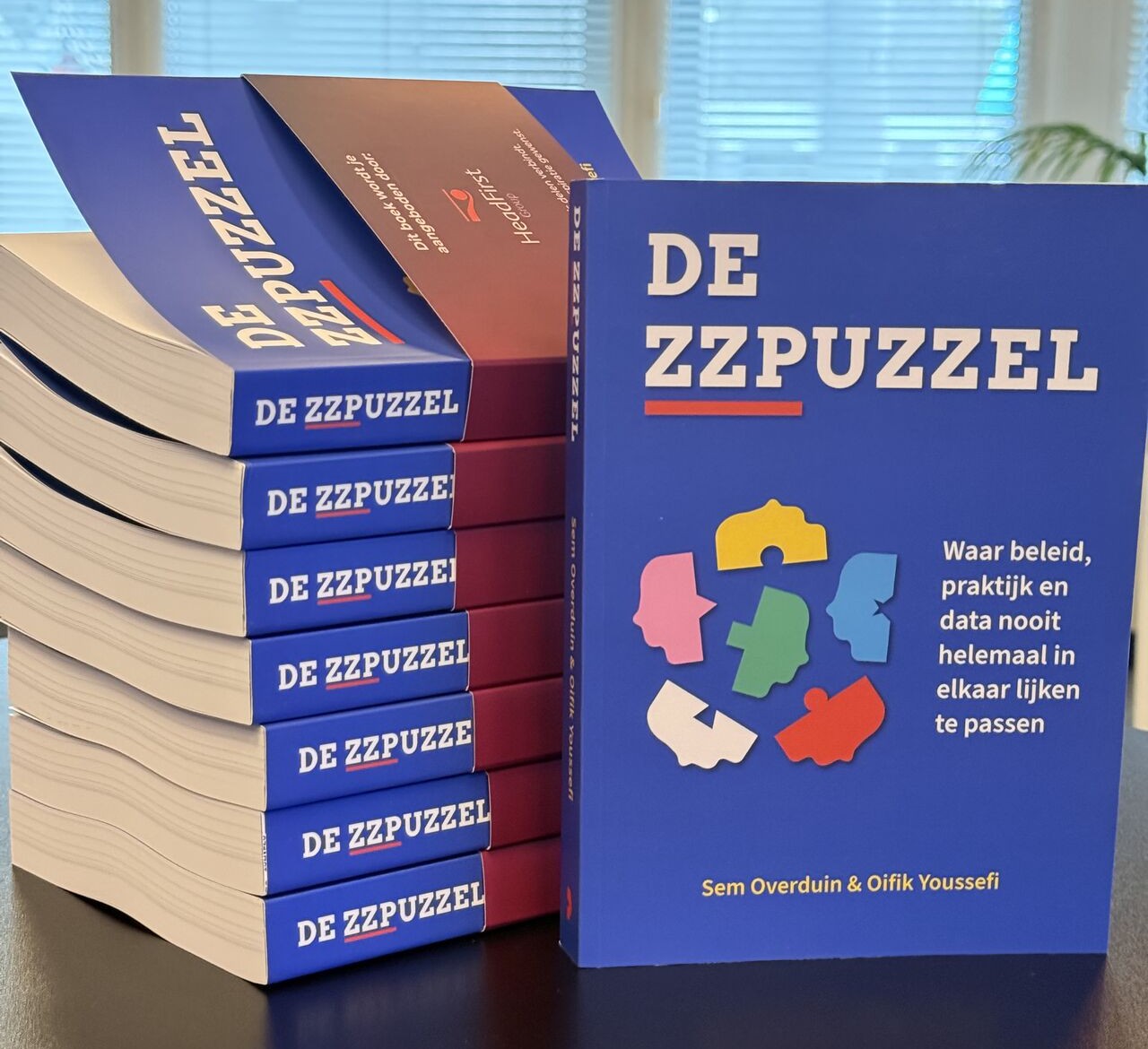
Public Affairscolleagues Sem Overduin and Oifik Youssefi wrote together the book The ZZPuzzel, a factual account of the self-employed dossier. The book came about after many discussions with labor market experts from the science, politics, and civil society. Persistent misinformation, one-sided image formation, lack of political decisiveness, and the complexity of labor law make the dossier a complicated puzzle. In this series of articles, the authors talk to stakeholders who contribute an additional piece to the puzzle.
To what extent do you think the self-employed dossier is a puzzle?
For me, this issue has been a puzzle for years. Since the introduction of the DBA Act, we have been grappling with the same problem: the employment relationship test. This is partly due to weak representation of the interests of self-employed people and partly due to strong lobbying from the business community. This makes it difficult to arrive at a balanced solution. The call for more clarity about the employment relationship has been heard for years, but the basis of the self-employed population often remains out of sight.
I have long been preoccupied with the question of what is fair for self-employed professionals. For me, the solution lies in sector-specific minimum rates, enshrined in law. That addresses the core of the problem.

The book examines the issue from perspectives such as misinformation, image formation, and political decisiveness. Which piece of the puzzle do you think is decisive?
"Political decisiveness. We have known for years that there is a problem, especially at the grassroots level of the market. People who structural struggle to make ends meet because rates are under pressure. Without political will, nothing will change. You can discuss it endlessly discuss about authority and entrepreneurship, but as long as you do nothing about the income position of vulnerable self-employed people, the problem will remain."
Which puzzle piece would you add to The ZZPuzzle?
“I prefer to solve the puzzle. Sector-specific minimum rates can get you a long way. Not a single generic limit, but lower limits calculated for each sector that correspond to the average number of billable hours and cost structure.
It is important that these rates are not optional. You can make them legally binding or link them to access to supplementary social security. This creates an incentive to operate within reasonable margins. Enforcement could, for example, be entrusted to the Labor Inspectorate.
You argue in an article on ZiPconomy for sectoral minimum rates for self-employed professionals. What is the core problem you want to solve with this?
A minimum rate is not a standard price, but a lower limit, comparable to the minimum wage for salaried employees. Below that level, it is not economically realistic to operate sustainably as a self-employed person.
In practice, self-employed people sometimes work at rates that are unsustainable, due to competitive pressure or a weak negotiating position.
My proposal addresses several problems at once: competition between employees and self-employed workers, bogus self-employment, lack of provision for retirement and disability, and poverty among self-employed workers.
Many people only look at the hourly rate, but forget that self-employed people cannot claim all their hours. If an editor works 37 hours, of which an average of 23 hours are billable, the rate must be calculated in such a way that, after deducting non-billable hours and costs, the editor earns at least the minimum wage. This requires a calculation per sector, not a single generic limit.
Wouter Koolmees attempted as Minister of Social Affairs and Employment in the past to introduce a minimum rate, but that proposal was rejected. Why would your idea work?
Koolmees' proposal was based on a single fixed rate. My proposal works with brackets, based on billable hours per professional group. This brings you in line with the reality of the sector.
A fixed limit, such as the €16 proposed at the time, does not do justice to differences between, for example, media, culture, or technology, and flattens everything. If you don't take those differences into account, it's not surprising that such a proposal doesn't make it.
Critics argue that a minimum rate reduces the scope for negotiation. What is your response to that?
That space is indeed shrinking. But right now, that space is so large that in some markets it is taking on antisocial proportions. The only thing that is no longer negotiable is a price level that drives people into poverty and makes it impossible to build social security. Everything above that remains negotiable. Currently, the risks lie entirely with the self-employed, while clients benefit from low rates.
A minimum wage makes the market more socially responsible. A recent motion by Mirjam Bikker (Christian Union), among others, calling on the cabinet to ensure that poverty figures do not rise during this cabinet term, was supported by the entire House of Representatives. All coalition parties also voted in favor.
Just as employees cannot be paid less than the minimum wage, self-employed people should also have a minimum income base. If you multiply the average number of billable hours by standard rates, in some sectors you end up with an annual income well below the minimum.
How does your idea for sectoral minimum rates relate to the legal presumption of employment, as proposed in the Clarification of Employment Relationships and Legal Presumption Bill?
The legal presumption is based on an hourly rate of €38 in 2026, accrued minimum wage, pension, disability insurance, and adjustment for non-billable hours. However, the percentages used are fixed, whereas in practice they vary per sector.
Some self-employed people will benefit from such a legal presumption. But that fixed limit is too generic. There are sectors in which people work for less than €38 and are clearly entrepreneurs.
At the same time, there are professions in which €38 is insufficient to exceed the minimum wage, given the limited number of billable hours per year. Some professions only have 700 to 1,000 billable hours per year. In that case, €38 is not much. So you have to look at the economic reality of a sector, and that is diverse.”
How do you view the bill? Self-Employed Persons Act, which the new cabinet is focusing on?
Clarifying the employment relationship is a positive step. However, if you simultaneously introduce obligations for disability and retirement without addressing low rates, you are placing the burden on the most vulnerable group. That is a blind spot.
If you calculate the lower limit correctly, self-employed people are by definition more expensive than employees, and price competition ceases to exist. This makes the type of contract less decisive.
What advice would you give to politicians?
Take sector-specific minimum rates seriously. Look at each market individually to determine what is needed to ensure that self-employed people earn at least the minimum wage. This will tackle bogus self-employment and prevent price competition between self-employed people and employees. It also creates financial scope for disability insurance and pension accrual.
In addition, technological developments such as AI will only increase the pressure on rates. Without a minimum threshold, poverty among the self-employed will continue to grow. Politicians have already stated that this must not be allowed to happen. Now it is time for action.
Request a free consultation
Questions about this? Please contact us.

Sem Overduin
Public Policy & Affairs Manager
Sem.Overduin@headfirst.nl
Oifik Youssefi
Public Affairs Officer
Oifik.Youssefi@headfirst.nl
Maaike van Driel
Head of Legal
Maaike.vanDriel@headfirst.group
Thomas ten Veldhuijs
Senior Legal Counsel
Thomas.tenVeldhuijs@headfirst.nl