
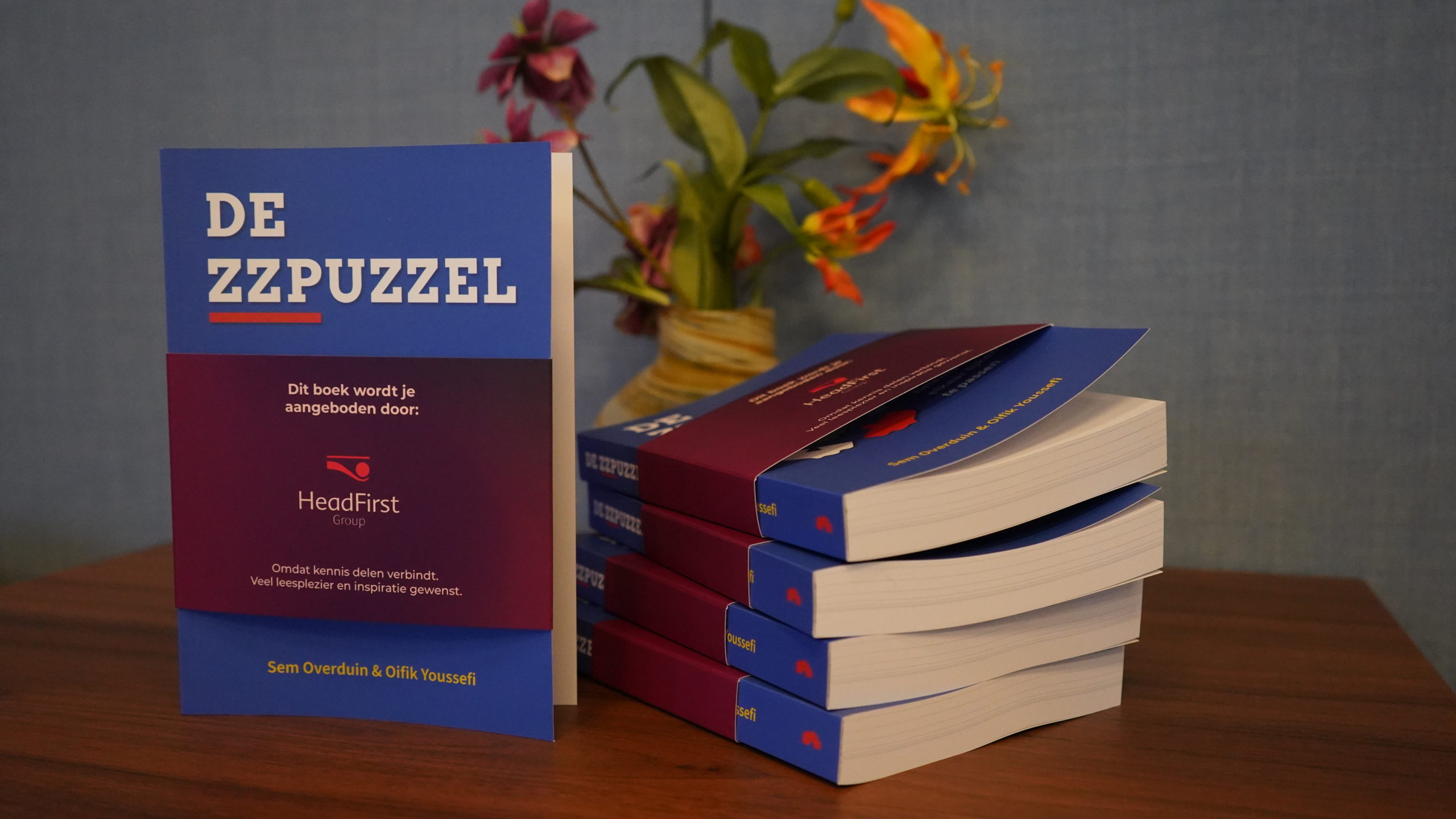
Public Public-colleagues Sem Overduin and Oifik Youssefi co-authored the book The ZZP Puzzle, a factual account of the self-employed issue. The book was the result of numerous discussions with labor market experts from academia, politics, and civil society. Persistent misinformation, one-sided perceptions, a lack of political decisiveness, and the complexity of labor law make this issue a complicated puzzle. In this series of articles, the authors engage in conversation with stakeholders who contribute an additional piece of the puzzle.
Which puzzle piece would you like to add to The ZZPuzzle?
The individual responsibility of self-employed workers. I don’t see this reflected enough in the discussion surrounding self-employment. Remember: if you don’t make provisions for disability or retirement, something is going wrong. Entrepreneurship also means looking ahead.
As far as I’m concerned, tax benefits should be made conditional. Consider the SME profit exemption or the self-employed tax deduction. Attach requirements to them. If you haven’t made the necessary provisions, why should you receive all the benefits? Both schemes are currently being significantly scaled back, but otherwise that would have been a worthy goal.
Many self-employed individuals are concerned about the changes to Box 3. To what extent is the current uproar, according to you based on actual risks, and to what extent on misinformation or framing?
Keep it simple: compare the current situation with what it will become. Right now, you pay taxes on a notional return. That’s fundamentally unfair, because it says nothing about what you’ve actually earned. So the move to taxing actual returns makes perfect sense.
The debate mainly centers on illiquid investments. Cryptocurrency has often been cited as an example lately, but the problem is being exaggerated in that context. If you have a profit, you can cash out a portion of it and use that to pay your taxes. That’s not an insurmountable hurdle.
The situation is more complex when it comes to assets that cannot be easily liquidated, such as real estate. In such cases, the basic principle is rightly different: tax is only levied when you actually sell the asset and realize the profit.
The basic principle is clear. You can tax liquid returns immediately. Non-liquid returns are taxed at the time of realization. That distinction actually makes the system more consistent.
The outrage often stems from a lack of clarity or how the issue is framed. Fundamentally, less is changing than is suggested. You will still pay taxes on unrealized gains—just as you do now—only no longer on a hypothetical amount but on what you have actually earned.
NOS reportreported reported in February that pension providers are seeing increased interest from self-employed people due to the new Box 3 rules. See Do this as a temporary reaction to the revision plans, or does it point to a structural shift in how self-employed people view their pensions?
In fact, every year we see an increase in the number of self-employed individuals registering compared to the previous year. This year, however, the increase has been significantincrease. I wouldn’t dare say whether this marks a structural shift. What is certain, however, is that there is a knowledge gap. A large proportion of self-employed individuals don’t even know that they can build up a tax-advantaged pension in Box 1. Most of them are still saving in Box 3.
That’s really the crux of it. In Box 1, you can make contributions and deduct them from your income tax, and you pay the capital gains tax. That’s actually much more advantageous. The reporting on this topic is often misleading. It seems as though Box 3 is the go-to option for entrepreneurs’ pensions, but that’s not true.
The announcement by Eelco Heinen (VVD), Minister of Finance, to revise Box 3 on a number of points, without broad consultation, drew a lot of criticism. What does such a spontaneous change of course mean, according to you do you think such a sudden change of course does to the confidence of self-employed professionals in politics regarding this issue?
I do think that’s generally a problem. In terms of continuity, this is undesirable. Just look, for example, at the debate surrounding the increase in the retirement age. A few years ago, the pension agreement stipulated that the increase would be slowed down, and yet the new coalition is deviating from that again. That undermines trust.
The same is true for Box 3. That issue has been dragging on for years and hangs over the market like a sword of Damocles. Everyone understands that the current system is unsustainable and that something needs to be done, but the lack of consistency makes it unpredictable. Continuity is crucial here, and it makes sense that self-employed individuals have become more critical as a result.
In addition, there is valid criticism of the way losses are handled, particularly the carryforward and carryback provisions. If you get that right and at the same time move away from the notional return, you essentially have a workable system.
The plans for the proposed Self-Employed Persons Act discuss making pension plans for self-employed individuals. To what extent does do you this requirement necessary for self-employed individuals?
From a business perspective, it would be interesting for us—I’ll be honest. Entrepreneurship isn’t just about freedom; it’s also about responsibility. At the same time, as a matter of principle, I’m not in favor of legal obligations.
The bill refers to “adequate provisions,” but what that means in concrete terms remains unclear. Everyone already contributes to the AOW; that much is clear. In my view, the focus should be on ensuring that self-employed individuals not only save for the future, but also have the means to enjoy the present.
If someone runs into financial difficulties, and this is clearly evident in their income tax return, it should be possible to withdraw funds early from a savings account set aside for later use. Currently, this is only allowed in cases of long-term disability.
Relax those rules. Make sure people can access their retirement savings sooner if necessary. The COVID-19 crisis has shown why this is essential. Many self-employed people had to dip into their own savings at the time. You need to take this seriously when designing the system.
Employees accrue pension benefits through group plans, while self-employed individuals must arrange their own coverage. In a labor market where people are increasingly switching between salaried employment and self-employment, critics argue that this distinction is becoming increasingly problematic. Where does this system begin, according to you ?
Pension systems in the Netherlands should, at their core, be individual-based. Under the old system, which utilized the Financial Assessment Framework, the emphasis was strongly on security. As a result, a significant amount of collective assets was accumulated, with a portion of those assets tied up in buffers to provide that so-called security.
The Future Pensions Act is changing that, but the structure is still partly based on a labor market that no longer exists. In the past, people often worked in a single sector for a long time, which was linked to a single pension fund. That model is becoming increasingly out of step with reality. The average 35-year-old already has about five pension plans.
Workers now move much more frequently between employers or clients, across sectors, and between different types of contracts. In this context, a system tied to employers simply makes less sense. By making pensions truly individual-based, they become neutral with respect to the form of employment. This better aligns with how people work today and ensures continuity, regardless of the form of employment.
Experts, including those in the book, generally advocate for a reform of the social security system in which both salaried employees and self-employed individuals contribute to pensions and disability insurance, among other things. What is your view you on this?
I am a strong advocate of this. Every working person should contribute to social security. That makes the system fairer and more widely supported.
There is a risk involved, though. If you’re a self-employed professional and temporarily don’t have any assignments or aren’t making a profit, it becomes difficult to make contributions. That requires flexibility in how you manage your finances.
That is precisely why personal responsibility remains essential. As a self-employed person, you need to build up a financial cushion and set aside savings so that you can stay afloat even during leaner times.
In closing, what is your advice to politicians in The Hague?
Ensure that self-employed individuals—in the event of financial hardship—can access their annuity funds sooner. Not to undermine the system, but to lower the barrier to saving money.
The point isn't that people should drain their retirement savings, but that this option is available in exceptional circumstances. The pandemic has shown that this need is very real.
It is precisely that flexibility that can convince people to start building up savings through Box 1. Thanks to the recent expansion of Box 1, people can also set aside much more, making it easier to use that buffer for other financial emergencies. A self-employed person certainly wants a nest egg, too. It’s just that for a self-employed person, that need can strike much sooner and at unexpected moments!
Request a free consultation
Questions about this? Please contact us.

Sem Overduin
Public Policy & Affairs Manager
Sem.Overduin@headfirst.nl
Oifik Youssefi
Public Affairs Officer
Oifik.Youssefi@headfirst.nl
Maaike van Driel
Head of Legal
Maaike.vanDriel@headfirst.group
Thomas ten Veldhuijs
Senior Legal Counsel
Thomas.tenVeldhuijs@headfirst.nl