

Looking back on the zzp dossier 2024: University lecturer Niels van der Neut on misinformation around false self-employment, the VBAR and the too-long enforcement moratorium
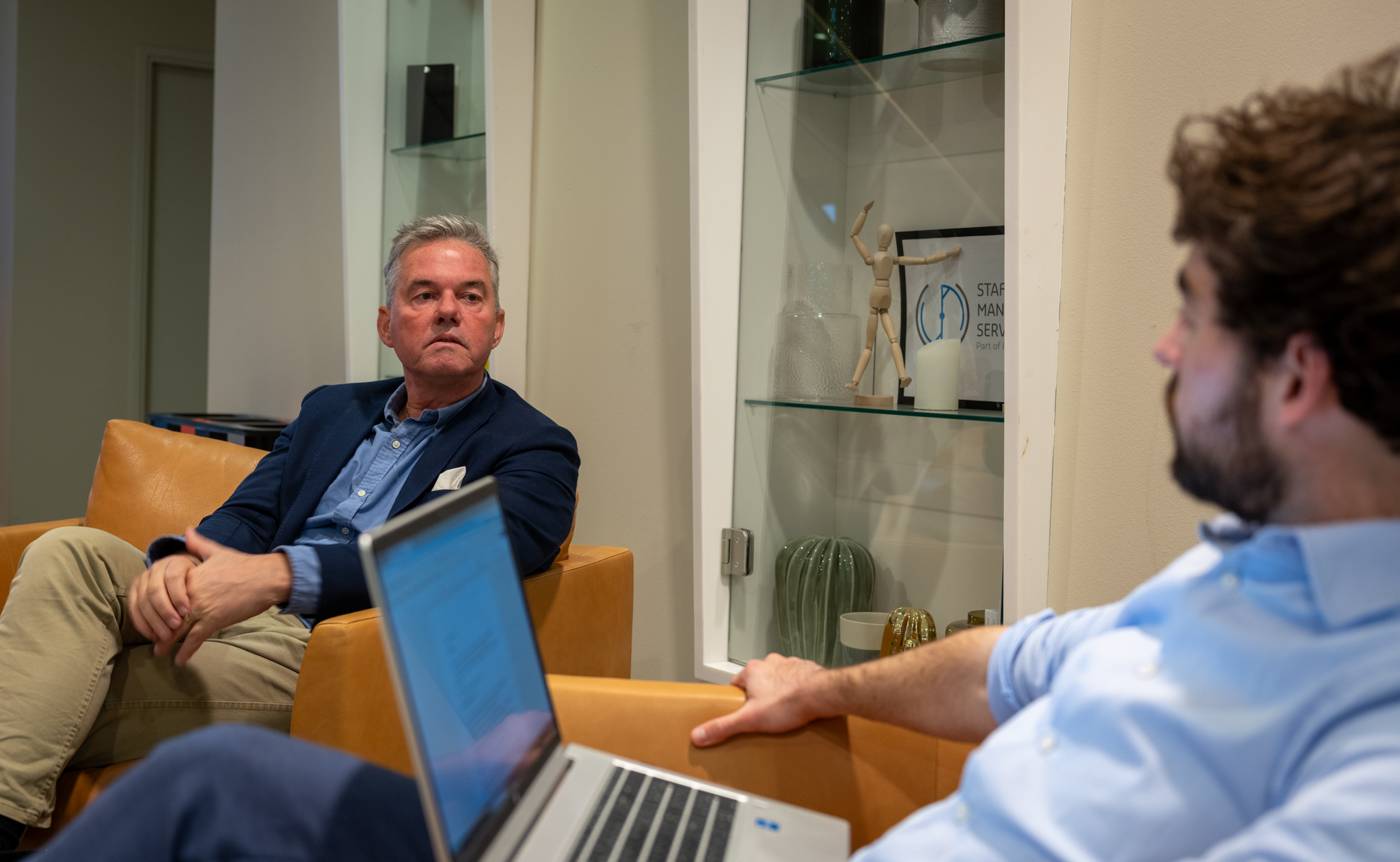
Let's face it: many self-employed people still find the legal frameworks for enforcement against false self-employment too unclear. "Nonsense," says Niels van der Neut, associate professor of labor law at the University of Amsterdam. "There is already a lot of legal handholding." In conversation with Oifik Youssefi, Public Affairs Officer at HeadFirst Group, Van der Neut shares his thoughts on the expiration of the enforcement moratorium, the misinformation about it online and on the role of social partners in unlocking the tightness in the labor market.
Still, people remain critical of the expiration of the enforcement moratorium because of market turmoil. However, the government and the Tax Administration indicate that the market is ready. How do you view this?
If the market is not ready for it, as far as I am concerned, that is mainly down to the market itself. The market has had a long time to prepare since the announcement in December 2022 that the moratorium would be lifted from January 1, 2025. Sure, sectors like education, healthcare and childcare are especially vulnerable given the staffing shortage; these sectors may find that reliance on self-employed workers has consequences. For some childcare sites, this may even mean temporary closure. But the flight to self-employment has been caused in part by poor employer practices. I call on employers, and actually social partners, to allow for certain desires of working people, such as some form of flexibility. This is what the Borstlap Commission already advocated: making permanent contracts less rigid and flexible contracts less precarious.
How do you listen to the Cabinet's ambition to come up with a clarification law like the Verduidelijking Beoordeling Arbeidsrelaties en Rechtsvermoeden (VBAR) Act, despite the legal clarity that you think is there?
Time has not stood still: the idea of the VBAR existed before the Supreme Court came out with the Deliveroo ruling. With this ruling, the Supreme Court took a clear line. Still, I can imagine quite well that people need such a clarification law , because it provides a framework and gives structure. Whether the VBAR fulfills that promise and is actually a clarification with respect to the Deliveroo viewpoints, I wonder. The Council of State itself has also ruled that the effectiveness of the VBAR in its current form will have little (positive) impact on the fight against false self-employment. Perhaps things will become a little more manageable, but perhaps we should not expect very big steps either. The practice wants certainty in advance, but that does not fit with how we in the Netherlands and Europe assess employment relationships: the actual situation takes precedence over the paper reality.
Finally, what was the highlight for you in the zzp file this year?
The announcement that the enforcement moratorium is really, really coming off as of Jan. 1, 2025. It has not been made easy for the Internal Revenue Service and SZW by continuing to extend the moratorium, but it seems we are taking a step in the right direction. The moratorium has lasted long enough.

And the low point?
The disinformation that is spread. This damages trust in the rules and in the executive agencies.
What in particular are you looking forward to in 2025?
I hope that we will have a more fundamental discussion about self-employed workers in, for example, partner structures and with specialists such as self-employed surgeons. Those legal (qualification) questions are much more interesting and complex than those about self-employed people in childcare or education. In addition, I would like to see the conversation start in society and in politics about a revision of the social security system and how employed and self-employed people contribute to it. And as an extension of my dissertation, it is still interesting that the focus might not only be on the differences in taxation and social security, but also be shifted to the civil law differences between employees and the self-employed. Of course, one might ask: shouldn't the conversation about these differences actually have been held much earlier, for example, when the enforcement moratorium was first announced?
*This interview is part of a series, in which in recent weeks the Public Affairs team has interviewed several experts closely involved in issues surrounding the self-employed and the labor market. The series consists of six interviews, which will be published in the coming weeks.
Request a free consultation

Questions about this? Please contact us.
Sem Overduin
Public Policy & Affairs Manager
Sem.Overduin@headfirst.nl
Oifik Youssefi
Public Affairs Officer
Oifik.Youssefi@headfirst.nl
Maaike van Driel
Head of Legal
Maaike.vanDriel@headfirst.group
Thomas ten Veldhuijs
Senior Legal Counsel
Thomas.tenVeldhuijs@headfirst.nl

Looking back at 2024: Bovib director Bart Smals on the limits of salaried employment and the 'right not to be salaried'
As a former VVD MP and now director of industry organization Bovib, Bart Smals is committed to the rights of the self-employed and the position of the intermediary industry within a rapidly changing labor market. In conversation with Sem Overduin, Corporate Affairs & Public Policy Manager at HeadFirst Group, Smals highlights the lack of a legal framework for modern working and shares his vision for the future. He advocates more freedom of choice: "Going into paid employment is a right, but the right not to do so should be better guaranteed." What does the expiring enforcement moratorium mean for the self-employed and intermediaries? And where will the Bovib be in five years? In this interview, Smals looks back at the zzp dossier in 2024, shares his insights and takes a critical look ahead to 2025.
Under your leadership, where will the Bovib be in five years?
I hope that we will then have a solution to the need for modern and flexible working, and that false self-employment will have been effectively addressed. The Bovib will then play a crucial role in connecting supply and demand and supporting clients, suppliers and self-employed workers.
The enforcement moratorium expires on Jan. 1, 2025. Do Bovib members know what awaits them?
I don't think anyone really knows. Everyone is looking for clarity, but the various rulings and rules - such as the Deliveroo judgment and comments by the minister and state secretary - do complicate things. The goal is to prevent false self-employment, and Bovib members are doing their best to do so. The problem is that no one at the front end, from the ministry to the Tax Office, can really say when you are compliant. Ideally there would be a traffic light model that you can rely on, rather than a situation where you have to wait and see, but we have to deal with this situation.
What do you notice about members leading up to January 2025?
Members are busy having conversations with clients and trying to advise on hiring policies based on the Deliveroo ruling. It is good that these talks are now being held and that Bovib members are taking a proactive role. Bovib members are professional organizations and take that responsibility.

As a former House member, how do you view the House's response to the enforcement plans of the Cabinet and the Internal Revenue Service?
The Chamber is right to be critical. The enforcement moratorium was put in place in 2016 because there was no clear legislation, that still hasn't changed. The Supreme Court has further colored the case law with the Deliveroo ruling, but it is really up to the legislature to provide clear legislation. In the Netherlands you have the right to work as an employee, but also the right not to. That deserves a good legal framework.
Did the end of the enforcement moratorium play a role in your political work?
Sure. At my first debate, MP Senna Maatoug of GroenLinks asked why the VVD, nota bene the party of enforcement, was so against enforcement of the DBA law. My answer was simple: if there is no clear law, you can't enforce it. I am in favor of enforcement, but only if there is a good legal framework. When even the judiciary says "approach it holistically," the answer is often "it depends.
As a VVD MP, you were critical of the VBAR and the role of entrepreneurial criteria. How do you currently view the VBAR?
When I was in the Chamber, I thought it was important to stand up for the right to free choice: you should be able to choose to be an entrepreneur. That should be reflected in the VBAR. The Borstlap Commission stated: 'fixed less fixed and flex less flex' - more balance in the labor market by making fixed contracts more flexible and flexible contracts more secure. But the way the VBAR looks now, it hardly matches that vision anymore. That's a shame. The right to entrepreneurship must be guaranteed. The VBAR should not force people into being employees if people do not want to be.
You also spoke out as a member of parliament about the representation of zzp'ers in the polder, for example in the SER. Why is that important?
I am a great supporter of the polder model because it brings different interests together to then reach solutions. But the interests of some groups, such as the self-employed, are not sufficiently taken into account. For a well-functioning polder it is essential that all interests are represented. I am therefore pleased that the SER now has seats for the self-employed - so they finally get a voice in decision-making.
Would the Bovib benefit from greater zzp representation in the polder?
Yes, definitely. The Bovib is growing and becoming more visible. A greater representation of zzp'ers would be good. Of course, the Bovib is not a union for the self-employed, but the self-employed are an important part of the labor market and the services provided by our members.
2024 has been an eventful year for the self-employed. What was a highlight for you?
Then I would like to go back a little further than 2024. In late 2023, Josette Dijkhuizen became a crown member of the SER because of her expertise on the self-employed. That is a step in the right direction, to give the interests of the self-employed a better place in the polder. Within the SER, after all, important long-term decisions are made regarding socio-economic policy in our country.
And a low point?
That the VBAR, in almost unchanged form, was sent to the Council of State. As a member of Parliament, and several parties with me, I was critical of the content of the VBAR. In my opinion, too little was done with it at the time. The Internet consultation in the fall of 2023 also produced many critical - and at the same time valuable - responses. The Council of State has now come out with a critical opinion and is bouncing the ball back. This could have been prevented at an earlier stage by making changes to the bill.
What do you expect from 2025 in this area?
I hope that the enforcement on false self-employment will mainly tackle the rogue parties and will protect vulnerable self-employed people. Especially at the base of the labor market the problems occur. That segment deserves extra attention and hopefully enforcement on labor relations will contribute to that in a positive way.
*This interview is part of a series, in which in recent weeks the Public Affairs team has interviewed several experts closely involved in issues surrounding the self-employed and the labor market. The series consists of six interviews, which will be published in the coming weeks.
Request a free consultation
Questions about this? Please contact us.
Sem Overduin
Public Policy & Affairs Manager
Sem.Overduin@headfirst.nl
Oifik Youssefi
Public Affairs Officer
Oifik.Youssefi@headfirst.nl
Maaike van Driel
Head of Legal
Maaike.vanDriel@headfirst.group
Thomas ten Veldhuijs
Senior Legal Counsel
Thomas.tenVeldhuijs@headfirst.nl


What is false self-employment and how do you prevent it?
In an ever-changing and dynamic legal landscape, it is critical that both self-employed individuals and clients have a clear understanding of what false self-employment entails and what consequences this can have. There is false self-employment when a worker works for a client as a self-employed person, while in the actual situation there is an employment contract. The client and contractor are jointly responsible for shaping the employment relationship correctly.
Here are the key points to consider if you want to position yourself as a self-employed person, or if you are a client working with self-employed people.
2. Risks to the worker in false self-employment
For the self-employed person themselves, the risks can be great if there is false self-employment. Consider:
- Recoveries of tax benefits: when the tax authorities correct the employment relationship, tax benefits such as the self-employment deduction and the SME profit exemption can be recovered;
- Fines and surcharges: the client may also face possible fines and surcharges of payroll taxes, as the self-employed person is subsequently considered an employee.Fines cannot be recovered from the zzp'er, after-tax payroll taxes can. However, in the Parliamentary letter of September 6, the government has announced that it will be lenient in the distribution of fines. For that reason, organizations that demonstrably take steps against false self-employment will not be fined in 2025.
3. Working on self-employment
To avoid false self-employment, it is essential to meet various criteria and elements associated with self-employment. These criteria include:
- Entrepreneurial risk: make sure you bear the financial risk for your business and the work you do. Commercial risk is part of entrepreneurship;
- As a self-employed person, make sure you make business investments of some magnitude. Consider investments in business equipment such as a laptop or investments in courses and training;
- Make sure that you actually behave as an independent entrepreneur in economic and social life. Consider the number of clients you have and an active role in acquiring new clients;
- It is important to actually implement contractual agreements in practice. Practice is leading, not agreements on paper. In legal jargon in legal jargon.
By meeting these criteria, self-employment can be demonstrated and prevent the Inland Revenue from qualifying the employment relationship as an employment contract.
4. All facts and circumstances count
It is important to understand that the assessment of self-employment is a weighing of all the facts and circumstances. There is no single decisive criterion; the employment relationship is looked at holistically, or in other words, the total context of the employment relationship is considered. This means that model agreements are useful, but only when they are actually observed in practice. As indicated above, the Inland Revenue and judges look beyond the paper reality: the facts and circumstances in the workplace are ultimately decisive in assessing the employment relationship.
Conclusion
Bogus self-employment is a complex and important issue. For both self-employed workers and clients, it is essential to be aware of the legal definition, the risks, and the steps that can be taken to ensure proper qualification of the employment relationship. Carefully considering all relevant facts and circumstances and encouraging entrepreneurial criteria are crucial to actually working as an independent contractor.
HeadFirst Group finds it important to inform clients and freelancers about the latest political-social developments. Watch our webinar back about the lifting of the enforcement moratorium and how to prevent false self-employment.
HeadFirst Group's Public Affairs team closely follows political and social developments. Our experts are ready for you - leave your details and we will contact you.
Questions about this? Please contact us.
Sem Overduin
Public Policy & Affairs Manager
Sem.Overduin@headfirst.nl
Oifik Youssefi
Public Affairs Officer
Oifik.Youssefi@headfirst.nl
Maaike van Driel
Head of Legal
Maaike.vanDriel@headfirst.group
Thomas ten Veldhuijs
Senior Legal Counsel
Thomas.tenVeldhuijs@headfirst.nl
